The Crack and the Claw
Coda To Volume 2
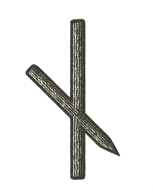
“Need is constricting on the breast;
it is a hard companion and a difficult choice
and a miserable existence.”
— Anglo-Saxon Rune Poem (Nauðiz)
Volume I stacked domains like an onion, or if one prefers older engineering diagrams, like turtles all the way down: emergence perched on emergence, each layer resting on the improbable competence of the one beneath it. Physics gave way to biology, biology to mind, mind to society, society to systems—carbon and silicon climbing parallel ladders, each rung a fresh insult to chaos. It was a tour of how anything coherent manages to arise at all.
If Volume I was an origami of paper-thin turtles, Volume II was the bull in the china shop–only with better manners.
It rammed in, scavenged, got uncomfortably close to things.
He glowered a stare. He scratched off some paint with one of his horns. He paused to listen for the hollow note. He collapsed the respectful distance that lets us declare the china shop a system: “working” simply because it has not yet shattered in a way loud enough to startle the right people.
It treated our familiar structures—psychological, institutional, economic, technical, civilizational—not as achievements to be admired from the lobby, but as assemblies worthy of a stress test. And in that harsher light, something became difficult to unsee: the foundations hold more often than fashionable despair would like to admit, but the load paths are wrong.
The bolts are loose. The joints are tired. The commons are underfed. The targets are confused. The machine still runs, the mind still narrates, the institution still processes, the dashboard still glows, and yet in the places where meaning, trust, fairness, signal, and governance ought to carry the deepest loads, the cracks are not cosmetic. They are structural.
Some of what we found was dramatic.
Much of it was worse: banal.
Not banal in the sense of harmless, but in the sense of recurrent. The failures were not always theatrical collapses with orchestral accompaniment. More often they were patterns. Stillnesses. Inertias. Ancient grooves waiting patiently beneath modern terminology. The mind that cannot update itself when tired. The machine that cannot explain itself when confident. The institution that mistakes throughput for care. The commons that cannot defend themselves once monetized. The public that confuses connection with wisdom. The civilization that keeps accelerating along the chosen axis and then acts surprised to find the target somewhere else entirely.
That is why this volume began, in spirit, with low battery.
A small technological stillness paired with a small human stillness. Two systems running short on reserve and reverting, under pressure, to whatever the past had already trained them to do. The scene was personal, but it was never private. It was a miniature of the larger mechanism: when coordination thins, when signal blurs, when pressure rises, when the loop tightens and pause goes missing, we do not become wiser. We become more ourselves. And “ourselves,” too often, means autopilot with a backstory.
Need, as the rune poem warns, constricts on the breast.
It squeezes choice until it begins to resemble fate. It turns governance into triage. It turns reflection into luxury. It turns ethics into something to be revisited after the emergency, after the quarter, after the launch, after the election, after the treatment, after the flood, after the child has already learned to live with the scar. A civilization can inhabit this constriction so long that it begins calling it realism, maturity, or just the price of scale. But need is not neutral. It is a systems condition. It can be inherited, manufactured, monetized, or merely neglected into permanence. Volume II has, in no small part, been an anatomy of that constriction.
In Volume I, our turtles looked like shields.
In Volume II, we found the hairline fractures.
Some shields were only scratched. Some had been patched so often that the patch had become the structure. Some had been flipped onto their backs—protective in theory, paralyzing in practice. The shortcut that once helped. The market story that once coordinated. The protocol that once protected. The queue that once scaled. The model that once clarified. None had to be wholly broken to become dangerous. It was enough that they continued operating under assumptions too old, too thin, too rushed, too industrial, or too local for the world now moving through them. That is the trouble with overfit systems. They do not fail by going dark. They fail by continuing with perfect good manners under conditions that no longer deserve their confidence.
And the cracks were not only in machinery.
They were in meaning.
In the stories we use to excuse inertia. In the labels by which we compress a person into a metric, a case, a nuisance, a user, a threat. In the myths that mistake growth for good, speed for seriousness, optimization for wisdom, and inheritance for self-sustaining reality. In the social contracts we pretend still exist because the forms are filed and the logos remain legible. In the systems we keep scaling long after they have stopped being aligned with what they claim to serve. Volume II has not argued that civilization is fake. That would be too easy and not nearly clever enough. It has argued something more awkward: civilization is often real enough to depend upon, but nowhere near as well tuned, well sensed, well governed, or well maintained as its own paperwork implies.
This volume has therefore been a diagnosis, not a verdict.
Its purpose was not to sneer at systems as though contempt counted as method. Its purpose was to name the antipatterns clearly enough that we can no longer keep calling them accidents. To show that the still arrow is not a mood but a mechanism. That the fractured basket is not merely personal disappointment but civilizational leakage. That weak observability, runaway dynamics, stale models, splintered purpose, degraded commons, rigid tools, and bounded minds are not a heap of separate misfortunes, but facets of one larger governance failure: action outrunning reflection, capability outrunning calibration, and systems scaling before they have earned the right to call themselves aligned.
That is why the final chapter had to arrive at pause.
Not because history should stop.
Not because fear deserves the wheel.
But because a civilization that cannot pause cannot steer.
Once that becomes plain, stillness changes its character. It is no longer mere stagnation. It becomes diagnostic light. The moment when the ghosts arrive. The moment when externalities stop being external, when the bill sits on the table, when the hidden debts re-enter the state of the system, when the old excuses lose a little of their perfume. The pause is not a decorative mood between crises. It is the first adult condition of redesign.
But diagnosis, sadly, is not a treatment.
Naming a monster does not kill it. Stress-testing a bridge does not rebuild it. Discovering the groove does not yet free the wheel. If anything, good diagnosis creates a new vulnerability: once you can see the architecture, you lose the innocence of pretending it is natural. Once you hear the hollow note, you no longer get to call it solidity. Once you notice the crack, you are left with the two most difficult options known to human beings: repair, or complicity in its spread.
That is the handoff.
Volume III must be about building.
Not utopia. Not slogans. Not “apps for virtue.” Not one more round of acceleration fever with a cleaner interface and more thoughtful fonts. Architecture. Recipes. Containers that deserve scale. Systems that can hold dignity without flattening it, intelligence without worshipping it, coordination without cruelty, adaptation without drift.
We are entering an age in which machine intelligence will not save us by being intelligent. It will only scale whatever we embed in it: our incentives, our governance, our value flows, our categories of care and neglect, our procedures for pause, our habits of power. If the structure is cracked, the intelligence will not heal it by magic. It will make the crack more efficient.
That is why the future cannot begin from acceleration fever.
It must begin from disciplined pause.
From rehearsal before deployment.
From redesign before scale.
From stewardship before extraction.
From scaffolds for bounded minds and governors for powerful machines.
From baskets that can hold obligation, commons that can survive use, forms that can still adapt to persons, and loops that remain interruptible before the irreversible arrives.
All of that belongs properly to the next volume. But it is earned here, in the after-silence of diagnosis.
So let this Coda do only what a Coda should.
Let it lower the light.
Let it leave the creak audible in the beam.
Let it leave the reader with the unpleasant advantage of having seen the crack clearly enough that comfort now costs more than change.
The old story was emergence.
This one was inspection.
The next must be composition.
We have audited the castles.
We have mapped the stillnesses.
We have felt the claw where need, incentive, and convenience dig into structure.
We have learned that many of the shields were also cages, and many of the optimizations were merely elegant forms of drift.
Now comes the hardest thing humans ever do: to revise the structures that once made them comfortable before those structures make them impossible. And nowhere is this impossibility more glaring than at the jagged edges of our current, calcified geopolitics, where our empires continue to mistake the furious motion of their individual parts for systemic stability.
While Russia was busy celebrating a victory even before their invasion started, many of us knew then that achieving victory in urban warfare to conquer Ukraine is a near-impossible feat. The only cities they have taken were won only by throwing tens of thousands of their own men into the meat grinder—much like they did to win St. Petersburg from nature.
And something like that is also true for the US 'expedition' in Iran. The difference is entirely cultural: where Moscow historically relies on a brutal human meat grinder, Washington prefers a high-tech meat locker. The strategy is wonderfully simple: pour the treasury into a naval blockade of Iranian ports, freeze Tehran's economy into submission, and then spend billions more trying to unsuccessfully carve a passage through a hostile Strait of Hormuz. The earlier Iran Nuclear Deal was the diplomatic equivalent of investing in mass transit—an attempt to actually change network behavior and divert traffic away from the bottleneck entirely. But to a man with a hammer, everything looks like a nail, and to a kid with a borrowed baseball bat, every oil field looks like, well, a piñata. So, to give credit where it’s due, our constitutional caretaker abandoned this logical framework to return to the comfort of the 'meat locker'—reverting to a multi-billion-dollar containment wall to serve as yet another empire’s piñata.
Here, our civilization behaves precisely like a macro-state in condensed matter physics. No matter how much furious, chaotic motion occurs at the microscopic level—whether it is thousands of Russian conscripts thrown into a mud-logged field, billions of American dollars pumped into the Persian Gulf, or a fleet of cooling units working desperately to freeze the shifting soil beneath Boston—the individual particles cannot change the underlying phase of the system. They are trapped in a state of civilizational stasis. Much like Boston—which, instead of fixing the systemic problem of urban transit itself, chose to freeze the entire waterlogged underground of its own city to manufacture a fleeting, pretend state transition just to carve a tunnel through solid ice rather than face the wet mess of reality—our empires continue to mistake localized structural manipulation for genuine system survival. But to force an unworkable reality to stay frozen, you don’t just summon the powers of Anna and Elsa from the movie Frozen—a film I confess I have never seen. As I understand it, Anna solved her crisis systemically with an act of love, whereas what Boston required was a similar, structural harmony around their high-traffic reality. Forcing an unworkable reality to stay frozen requires a geometric explosion of energy, an unsustainable expenditure that eventually fractures the entire architecture.
Four decades and seven months ago, America and engineering welcomed me with the Challenger explosion, a tragedy fundamentally born of tech-driven hubris. In this latest Promethean “special military operation,” the Strait of Hormuz has stepped right into the role of the O-ring of the wider 2026 Iran war. Now we are engaged in a great naval struggle, testing whether that military machine, or any machine so conceived and so dedicated, can long endure when its fate is brought low by a single, unyielding loop of frozen rubber because men in high offices altogether forgot the unforgiving laws of physics.
And this is where the author realizes that he is not Abe. But the structural delusions remain exactly the same. Washington’s trillion-dollar military apparatus has been successfully paralyzed by a single geographic bottleneck. It turns out that no matter how many billions are spent on precision interceptors or naval escorts, the entire imperial architecture still fractures at a narrow twenty-mile chokepoint. Much like Boston’s infamous 'Big Dig,' which spent billions burying a traffic problem it could never actually solve, the US is happily burning through its treasury to contain an asymmetric conflict, proving yet again that both empires eventually run into the ceiling of their own hubris [1.1].
It leaves us with a stark, diagnostic lesson: we must remain deeply skeptical of the things we call 'Big'—projects and policies that are gargantuan in physical footprint but entirely bankrupt of macro potential, mistaking raw mass for a true systemic solution. Yet a lethal corollary stands at the other end of our O-ring: just because a component appears minuscule in scale, we can never discount its disproportionate power to fracture the entire system. Indeed, the physics of condensed matter tells us that when a true systemic force is channeled through such a narrow, high-leverage node, the resulting wave of transition can trigger a sudden, runaway melt—causing a seemingly permanent, calcified state to dissolve into a fluid new reality far faster than any of the old gatekeepers ever thought possible.
Predictably, when you attempt to lock a quarter of the world’s seaborne energy supply inside an un-chilled, highly explosive metaphorical cupboard, global markets do not respond with quiet stoicism. By mid-2026, the frozen reality of the Hormuz bottleneck has thawed into pure economic pandemonium. With daily ship transits through the Strait plunging to a near-halt, Brent crude has routinely broken past the triple-digit barrier, transforming a local standoff in the Gulf into an inflationary bonfire. Yet, the ultimate testament to our current Promethean gridlock is the Pentagon’s latest high-tech masterwork: the so-called 'dark shuttle'. Rather than solving the systemic friction, the United States military is now reduced to acts of elaborate maritime theater, expending multi-million-dollar escort operations just to guide a heavily rationed trickle of supertankers along the Omani coast—proving that while a trillion dollars can buy a remarkably sophisticated flashlight, it still cannot illuminate a path through a fundamentally unworkable terrain.
As I pen these notes in early September 2026, the calendar itself seems to be mocking our collective lack of foresight. Behind the smoke of the Persian Gulf, the United States has just finished celebrating its 250th anniversary—a brief, spectacular sprint as history’s premier institutional empire. Yet, just across the water sits Iran, the current grumpy-caretaker version of a Persian civilization that endured as an ideological empire for twenty-five hundred years before Washington was even a blueprint.
Now, as the shadows lengthen toward the 25th anniversary of September 11, we are forced to look back not just at a quarter-century of endless expeditions, but at the entire structural trajectory of Western power. We stand at a civilizational crossroads, staring into a hyper-technological future that threatens to outpace our capacity to govern it. The old systems have run out of road. The machinery is jammed. To find a way forward, we have to look away from the crashing tides of collapsing empires and turn our gaze north, toward an entirely different template for the next century...
Mein Vater, mein Vater, jetzt faßt er mich an!
Erlkönig hat mir ein Leids getan! — Goethe, Erlkönig