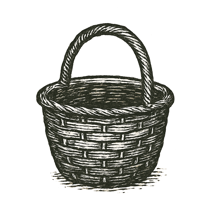
The Basket We Carry
Overture To Volume Iii
“Freedom is nothing else but a chance to be better.” — Albert Camus
The high ceilings and lakefront glass made even ordinary family noise feel curated—less living room than gallery. Lofty white frames. Pillars of light. A quiet so clean it bordered on surgical. The kind of space designed by people who trust structure, straight lines, and load-bearing truth.
At the center of it sat the Architect—the patriarch of that moment—commanding the sofa even in repose. A foldable walker stood beside him like a modest piece of good engineering: dutiful, unobtrusive, patient. He lifted his iPhone. The screen came alive with a photograph of a woman in her forties, smiling with the sort of calm that survives decades without filing a complaint with time.
Across the room toddled the other pole of the family’s magnetism—baby Ryan, one year old, newly promoted to standing and walking, a tiny engine of pure possibility. The Architect angled the phone toward the child. It was not a casual look-how-cute gesture. It was closer to a handoff. Legacy offered across a generational distance too large for language. That was your great-grandmother, the gesture said, even if the words themselves never fully arrived.
Ryan stopped. He steadied himself. He looked.
Then something happened that did not belong to the standard operating system of toddlers. He did not reach for the device. He did not swipe at the glass. He did not grin, babble, or perform the ordinary rituals of one-year-old mischief. Instead he stood perfectly straight—as if his small spine had discovered an ancient protocol—folded his hands behind his back, took a deliberate step away, and bowed his head.
Not clumsy. Not playful. Not shy. It was a bow with gravity. A bow that looked less like imitation than ritual.
The room cooled into silence. The Architect withdrew the phone, momentarily unmoored, then extended it again, as though repeating the prompt might return the universe to its expected behavior. Ryan repeated the sequence. Straight spine. Hands behind the back. Step away. Bow.
A third time. Same posture. Same precision. A toddler performing reverence for a face on glass.
In a house built on engineering confidence, we suddenly found ourselves in the presence of something that felt like a glitch—not in the phone, but in our assumptions.
The baton was being passed. And with an electric little chill we realized that we did not quite recognize the hand that had reached out to take it.
The woman in that photograph was my mother—the same woman who once made a living circling rare events, hunting for those tiny breaks where the universe betrays its symmetry. In that room it felt as though she had dropped another link into the chain—not of creation this time, but of continuity.
Here, of course, the story tries to fork into two roads—one paved with miracles, the other with mechanisms. My mother’s lineage came with its own mythology, the kind families preserve the way they preserve heirlooms: stories of Sufi saints, prodigies, blessed continuities. In another kind of household, the bow would have been declared proof—an unsolicited window into sacred order. A sign. A visitation. A quiet metaphysical memo.
But I am not built that way. I have spent too many years watching human beings confuse longing with evidence. I have lived too long inside the machinery of modern explanations to hand out miracles cheaply, even to someone I loved enough to wish they were true.
And yet I will admit this much: the moment threatened my inner symmetry. It tempted me to grant her a pedestal—deserved, luminous—even while knowing how often luminous things arrive with biological anchors and more pedestrian paperwork than the mystics would prefer.
So the rational response was to look for the nearest safe hypothesis. The question was put to the child’s circle: could Ryan have parroted the wonder—the laughter, the applause, the body language of the room? It was confirmed that this was the first time he had been shown that picture. The running explanation—the one that let the furniture of the mind return to its appointed places—was that perhaps the one-year-old thought his picture was being taken and had decided, in his own small and ceremonial fashion, to pose.
Maybe that was all it was. And despite it being all, there was more to it. Maybe that is the point.
Because we do, in fact, maintain a private compact with ourselves. We allow a certain amount of poetic truth. A few rituals. A few warm irrational corners. A little private incense in the machinery. Harmless fictions to help us move through this fragile bubble called life without demanding that every tenderness submit to laboratory protocol.
Sitting there, watching the loop repeat, I could almost hear the Architect reciting one of those haunting Persian verses he used to murmur when the room grew quiet.
به هر سو رقص بسمل بود، شب جایی که من بودم
(In every direction, the fleeting dance whirled around me, in that strange place where I stood last night...)
I always found the line chilling because it felt like his own quiet realization of his own end, a man looking back from the far edge of ninety years, watching a one-year-old child just stepping onto the floor to begin the same brief choreography.
But it is a two-way pact with reality. In return, we are not permitted to be fools. We must remain on the same page with reality—especially when reality is about to become editable.
So take this as a metaphor, not a manual: you may enter Virtual Reality, even blend imagination with the physical world in Augmented Reality, but you must still know where the furniture sits in the real room. You do not get to walk through a solid chair simply because you prefer the story in which you can.
And the danger only deepens once you step outside the metaphor.
Because the next reality we are building will not be made of wood and glass. It will be made of systems: incentives, identities, value flows, governance structures, machine intelligence—an informational electricity that will power decisions the way literal electricity powers cities. When it works, it will feel invisible. When it fails, it will feel like gravity turning on the wrong people.
That is the core of this volume. The future—symbolized by Ryan’s uncanny bow—is already in the room. We must choose our myths wisely. Because in the age now arriving, myth is not merely a bedtime story. It is an interface. And interfaces, once scaled, become architecture.
Whatever the truth of that moment—saint or pose, miracle or mechanism—the act itself stood as a reincarnation of something we desperately need: hope with posture. Not hope as mood. Hope as discipline. Hope as design constraint.
The Architect’s phone was a small glass basket—carrying a face, a memory, an inherited glow. The child responded not with consumption, but with reverence. And the room full of adults did what our civilization is about to do at scale: we tried to decide what the signal meant, and what we should do with it.
The man watching all this—trying to keep one foot in the sacred and one foot in the sane—was me.
Volume II was the autopsy: a taxonomy of why our arrows stall, why our castles crack, why our myths become cages. Volume III is what comes after one stops narrating the damage and starts designing the repair: architecture, not applause. A framework, not a slogan. A loom sturdy enough to weave freedom without weaving a fresh tyranny into the hem.
This is where the basket stops being something we merely clutch … and becomes something we build. Not perfectly. Not purely. Not alone. But deliberately—before the systems we inherit decide, on our behalf, what kind of reverence the next child will be trained to perform.